

The short answer
Keep priorities, offer accuracy and commercial decisions inside the business. Assign delivery to people with the skills and available time to do it, whether they work in-house or at an agency. Every shared workflow also needs one person responsible for checking that the pieces work together.
A worked example: the quote request nobody owned
Consider a hypothetical distributor. Marketing writes the service pages, an agency builds the WordPress form and operations runs the CRM. After a form update, requests for one product category reach the CRM but aren’t assigned to sales.
“The agency handles the website” doesn’t tell anyone who should fix the handoff. The form can send successfully while the sales process fails. Here’s a more useful assignment.
| Part of the journey | Owner | Evidence needed |
|---|---|---|
| Customer-facing wording | Marketing lead | The form asks for the information needed to route and answer the request. |
| Fields and assignment rules | CRM owner, with sales approval | Each product category maps to the agreed record and sales team. |
| Receiving and following up | Sales manager | A named recipient can see the request and knows the next action. |
| Complete journey | Development lead coordinates the test | A representative test reaches the right CRM record and recipient, and the visitor receives confirmation. |
Inventory the work before choosing the team
A capable marketer may not have the skills to repair an integration. A good developer may be waiting for content or a sales decision. Before choosing a delivery model, find out which work is actually uncovered.
Review the last few months: content changes, landing pages, development fixes, plugin updates, search work, forms, integrations and reporting. Include requests that stalled. For each category, record the skill needed, current owner and time available.

Include coordination and approval time. An agency can do substantial delivery work, but someone in your business still needs to answer questions, resolve priorities and approve accurate offers.
Check capacity by skill, not total team hours
Knowing how to do the work and having time to do it are separate questions. Use the same planning period and unit for each discipline. Don’t count someone’s entire working month as available website time.
In this hypothetical month, development needs 24 hours but has 10 committed. Content needs 12 hours and has 18 available. There’s still a 14-hour development gap; six spare writing hours won’t close it.
Choose which work to defer, simplify, reassign or fund. Leave unknown demand or availability marked unknown, then compare estimates with completed work before using them as a staffing plan.
| Discipline | Required / available | Gap | Decision |
|---|---|---|---|
| Development | 24 / 10 hours | 14 hours uncovered | Protect the critical integration fix; defer, simplify or assign the remaining work. |
| Content | 12 / 18 hours | No gap; 6 hours remain | Keep the planned content work covered. This does not create development capacity. |
| SEO and reporting | Not yet estimated | Unknown | Estimate the agreed work and confirm an owner’s availability before committing. |
Keep business decisions with the business
Your company should own the service offer, product accuracy, audience priorities, commercial policies, and final approval of public claims. Sales should contribute the questions and objections buyers actually raise. Operations should confirm how a proposed workflow affects fulfillment or service delivery.
An agency can challenge assumptions, recommend an approach, and turn expertise into useful website content. It still needs an authorized decision-maker when departments disagree. For a new quote-request journey, marketing may want fewer fields while sales needs an equipment list. Give one person responsibility for resolving that tradeoff with evidence from both teams.
Separate business approval from technical acceptance. The business decides whether the offer is accurate and suitable. The delivery team verifies that the agreed page or workflow functions correctly. A stakeholder saying the design looks good does not establish that a form reaches the right person.
Finally, define which decisions the delivery team can make without another approval round. Routine corrections within an approved scope may need a different process from changes to prices, service promises, account permissions, or major integrations. Clear decision boundaries make collaboration faster.
Compare in-house, agency, and hybrid arrangements
An in-house team can build deep familiarity with the company and work closely with sales and operations. That advantage matters when website decisions require frequent internal context. The business also takes responsibility for recruitment, skill coverage, management, and continuity when someone is unavailable.
An agency can provide access to several specialties and an established delivery process. Its usefulness depends on the actual people assigned, their capacity, and what the agreement covers. A broad service list does not establish that every discipline is available for every request.
A hybrid arrangement keeps selected work inside the company and assigns other responsibilities to an external team. It can work particularly well when internal marketing has strong business knowledge and content capacity, while development, design, technical SEO, or integration work needs additional coverage. Its main challenge is coordination: overlapping responsibilities can create duplicate effort or unattended tasks.
Use the comparison below to identify what each model would require in your business. None removes the need for clear priorities and access to the people who can make decisions.
| Dimension | In-house | Agency | Hybrid |
|---|---|---|---|
| Skills | Build and maintain the required mix internally | Verify the disciplines and people included in scope | Assign each discipline explicitly across both teams |
| Capacity | Balance website work with other internal duties | Agree a realistic queue and capacity for the engagement | Plan around the capacity and dependencies of both teams |
| Accountability | Name an internal delivery lead and business owner | Name an agency delivery lead and an internal decision-maker | Give each workstream one lead and define the handoffs |
| Approvals | Arrange business and technical review internally | Provide timely business decisions and acceptance | Specify which team reviews content, design, and implementation |
| Dependencies | Manage outside platforms and vendors directly | Define which vendor coordination the agency handles | Avoid leaving a dependency between two partially responsible teams |
| Continuity | Document work and provide coverage beyond one person | Confirm documentation, access, and transition terms | Keep shared records and a clear escalation route |
Write the responsibilities matrix before work starts
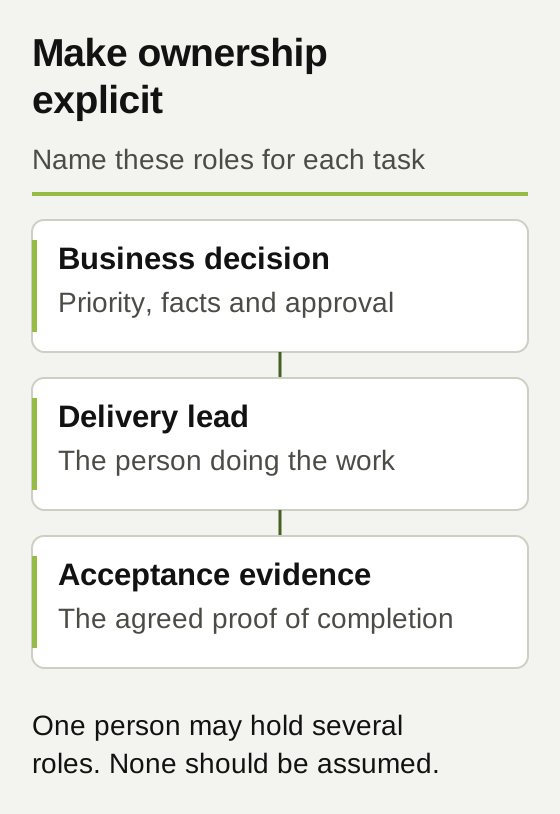
For each responsibility, identify the person who performs the work, the person who can make the decision, and the evidence needed to accept it. “Marketing and the agency” is too vague if neither knows who must act next.
The following matrix is an example hybrid arrangement, not a fixed AV Social Strategies service package. Replace the role names with people and adjust the assignments to the agreed scope. One person may hold several roles; the responsibility still needs to be explicit.
At AV Social Strategies, Mike handles development, Roo handles design, and Penelope handles SEO and account management; Abraham handles sales and contributes strategy. Those disciplines need to connect to the client’s own business and operational knowledge. The engagement should specify the responsibilities and delivery capacity being assigned rather than treating a team introduction as an unlimited commitment.
| Responsibility | Delivery lead | Business decision / contribution | Evidence of completion |
|---|---|---|---|
| Prioritized backlog | Agency account lead maintains the agreed queue | Business owner selects priorities and resolves conflicts | Ordered work with scope, dependencies, and owners |
| Content and offer accuracy | Assigned writer or content owner | Subject expert approves claims and service details | Approved content and recorded open questions |
| Design and usability | Design lead | Business owner confirms requirements and relevant feedback | Reviewed page or workflow against agreed buyer tasks |
| Development and releases | Development lead | Authorized owner approves material scope and release timing | Test results, release record, and recovery plan |
| CRM or operational integration | Named integration lead | System owner confirms fields, rules, and receiving workflow | End-to-end test and an owner for exceptions |
| SEO and reporting | SEO or measurement lead | Sales provides qualification and outcome feedback | Defined metrics, source gaps, and next decisions |
| Hosting and specialist issues | Named provider or specialist | Business owner maintains the appropriate service relationship | Known support route and documented responsibilities |
Make provider boundaries and access explicit
A WordPress agency, hosting provider, CRM vendor, and cybersecurity specialist may each own different parts of the environment. Identify who handles each concern and who coordinates when an issue crosses those boundaries. Do not assume a maintenance agreement covers every hosting or security incident.
AV Social Strategies refers hosting needs to providers such as Convesio and WP Engine and refers specialist cybersecurity needs to appropriate expertise. Where a website engagement includes coordination, define that responsibility alongside the provider’s own agreement. Routine WordPress updates can be part of maintenance without making the agency the owner of every infrastructure service.
Match permissions to assigned work. WordPress roles and capabilities distinguish tasks such as editing content, publishing, managing plugins, and administering users. Review the actual permissions in your installation and avoid giving broad access solely because someone participates in the project. In a standard installation, an Editor can publish and manage content without the default capabilities to install or update plugins. Plugins and custom roles can change permissions, so verify the actual account rather than relying on its role name alone. An approval responsibility also does not require permanent Administrator access.
Maintain company-controlled access to essential accounts, named contacts for providers, and a process for changing permissions when responsibilities change. The goal is continuity: the website should remain operable when a person changes roles or an engagement ends.
Evaluate the ongoing relationship by how work moves
Before committing to an ongoing arrangement, review how requests enter the queue, how priorities are selected, what the agreement includes, and what requires separate scoping. Ask how urgent issues affect planned work and how blocked decisions are brought back to the business owner. Do not infer unlimited delivery from a monthly fee.
Look for a usable record of approved work, completed changes, pending decisions, and observed results. Reporting should explain what changed and what needs attention. The business should also be able to see when its own missing content, access, or approvals are delaying delivery.
For SEO work, ask for the recommendation, its supporting evidence, the person responsible for implementation, and how the result will be assessed. Google's advice on hiring an SEO recommends checking references and asking how changes, expected results, and measurement will be explained. In a hybrid team, also establish who turns an accepted recommendation into a released change; an audit alone does not fill that delivery role.
Use our WordPress agency selection guide to assess a potential partner’s evidence and process. Then use the responsibility and capacity examples here to agree what that partner will own. A strong agency still needs a workable assignment.
If your website depends on one overstretched person or work repeatedly falls between teams, discuss your WordPress priorities with AV Social Strategies. Bring the current backlog and the people involved. We can help identify where additional WordPress expertise would make the ownership model more complete.
Decide the ownership model with these five questions
- Which recurring work has a capable owner with real capacity?
- Which commercial decisions require someone inside the business?
- Where do design, development, SEO, and operational responsibilities overlap?
- Who verifies the complete buyer journey across providers and systems?
- What documentation and coverage keep the work moving when someone is unavailable?
Sources and further reading
WordPress documents account permissions; Google’s guidance helps evaluate an SEO provider. The handoff and capacity examples are hypothetical planning examples, not client records or a fixed service package.