
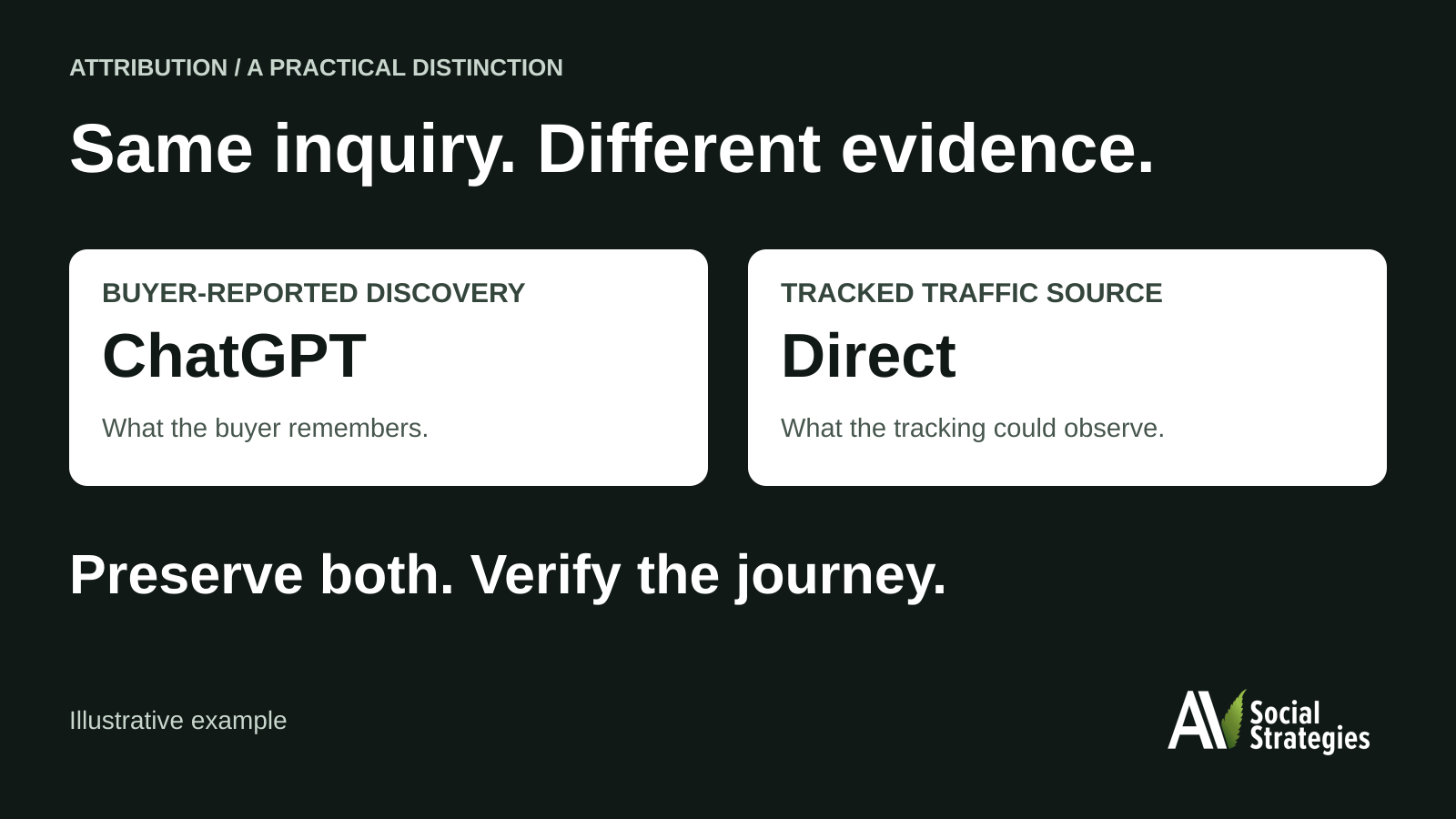
A prospect fills out your contact form. Under “How did you hear about us?” they select ChatGPT. Your CRM labels their website traffic Direct.
Now someone has to decide which source goes in the report.
Before you change either field, ask what each one actually measures. The customer is telling you how they remember discovering your company. Your analytics system is classifying the traffic it could observe. They may be answering different questions. Neither field, by itself, tells the whole story. First verify where each value came from; a mismatch can also reveal a mapping error or mistaken recollection.
For B2B leaders investing in WordPress websites, SEO and CRM integrations, the useful next step is to diagnose the mismatch—not force both answers into one source field.
What Direct traffic actually tells you
Direct traffic does not prove a prospect typed your website address because they already knew your brand. Google Analytics describes direct traffic as traffic without a clear referral source. A typed URL is one possibility; lost campaign information, redirects and some ad blockers can also contribute to Direct classification. [1]
Consent is a separate measurement issue. In Google’s basic consent mode, denied consent means no data is sent to Google; advanced consent mode can send cookieless pings instead. Neither behavior should be reduced to a blanket assumption that denied-consent visits become Direct. [5]
Consider this illustrative journey: a buyer asks an AI assistant for potential vendors, remembers your company name, and visits your website later. The visit may be classified as Direct even though the buyer credits the AI recommendation with the introduction.
That is a plausible explanation, not a reconstruction you can prove from a Direct label alone. A rise in Direct traffic is not evidence that AI recommendations are increasing. Investigate the tracking and gather more evidence before assigning credit.
AI referrals can also be identifiable. As of October 30, 2026, HubSpot documents an AI Referrals category for recognized AI platforms, using referring-domain or campaign-parameter information. [2] GA4 documents an AI Assistant channel for recognized AI referrals, while Google AI Overviews and AI Mode remain Organic Search. [6] These platform rules can change. Recognition depends on available evidence; an AI-influenced journey is not necessarily an identifiable AI referral.
Three questions hiding inside one source field
“Where did this lead come from?” sounds straightforward until sales, marketing and finance answer different versions of it.
- 1. How did the buyer discover us? A form response or sales conversation can capture what the buyer recalls. That might be ChatGPT, a colleague, an event or a LinkedIn post.
- 2. How did a tracked visit arrive? Analytics may identify a referral domain, a tagged campaign or an organic search. That evidence describes an observable interaction, not necessarily the first time the buyer heard your name.
- 3. Which interactions receive credit for the outcome? An attribution model applies rules to the available history. A report can assign credit consistently without capturing every influence on the purchase. In GA4, first-user, session and event-scoped reports answer different questions. A final Direct visit also need not receive conversion credit; the model may credit an earlier eligible interaction. [7a] [7b]
These questions overlap, but they are not interchangeable. A buyer can discover you through a colleague, research you in an AI tool, click a search ad and return directly before submitting a form. One label compresses that entire journey into a single answer.
Self-reported attribution needs its own limits
The customer's answer adds context your tracking may miss. It is still a recollection, not a complete activity log.
People may not remember every interaction or its order. They may choose the closest dropdown option or use “Google” as shorthand for researching online. Question wording and response choices can shape answers too. [8] An unanswered field should remain Unknown, not become Direct or “no AI influence.”
Keep the answer as self-reported evidence. Do not quietly convert it into a verified click, a confirmed first touch or proof that one channel caused the sale.
Diagnose the mismatch before changing the record
Use one traceable inquiry to work through four checks. This is an investigation sequence, not proof that any particular explanation applies to your lead.
- 1. Name the evidence. Identify the exact CRM property, form question, date range and analytics scope. Check whether the report describes remembered discovery, a tracked session or model-assigned credit.
- 2. Inspect the recorded interaction. Review available referrer, campaign parameters, landing page and timestamps for that inquiry. A recognizable AI referral is evidence of an observed interaction; a Direct label without that detail does not reconstruct what happened before the visit.
- 3. Check the handoff. Compare the original form answer with the saved CRM value. If the values differ, investigate field mapping or normalization before calling the discrepancy an attribution problem. Keep the original answer and tracked source intact.
- 4. Record the conclusion and its limits. Distinguish a verified mapping error, an observed AI referral and a buyer-reported introduction with no matching tracked referral. If the cause is unresolved, say so. Do not turn an unanswered discovery question into Direct or no AI influence.
Preserve original and latest traffic-source definitions rather than repurposing them. In HubSpot, Original Traffic Source means the first known web source and Latest Traffic Source means the most recent known web source. Changing a record’s traffic source clears its drill-down properties. [3]
For the implementation checklist, see our B2B website-to-CRM handoff guide. It covers the receiving record, preserved context, ownership and follow-up; this article focuses on interpreting the ChatGPT-versus-Direct discrepancy.
For the opening example, a reasonable record is self-reported discovery: ChatGPT; tracked traffic: Direct. If someone asks which is “correct,” the answer depends on which question the report is supposed to answer.
Close a specific evidence gap, not every visibility gap
Use consistent campaign tags on external marketing links you control. Google Analytics supports UTM parameters for details such as source, medium and campaign. Test that those values survive redirects and reach the destination as intended. [4]
If the buyer’s answer is ambiguous, clarify whether ChatGPT introduced the company or helped with later research. Keep the original response and question version. Treat the clarification as self-report, not a recovered click history.
If mapping or tagging looks wrong, define a labeled test that checks that specific boundary. A successful test explains the system’s behavior under those conditions; it does not prove the path taken by an earlier buyer.
Keep collection proportionate. Respect consent choices, use access and retention controls appropriate to the data, and keep personal or sensitive information out of campaign URLs. More tracking is not permission to collect everything.
Make budget decisions with outcomes and uncertainty visible
Keep inquiry received, qualification, confirmed booking, attended meeting, opportunity and closed revenue as separate outcomes. Advance each only when its own evidence exists. A submitted inquiry is neither a qualification decision nor a booked meeting. Compare self-reported ChatGPT discovery and tracked source without adding overlapping groups into a revenue total.
A handful of people naming ChatGPT is a useful signal to investigate. It does not establish a reliable conversion rate, prove incremental revenue or justify moving an entire budget. Revenue associated with a source is not automatically revenue caused by that source. For a small pipeline, use the evidence to identify questions worth testing, not to present a precise AI ROI claim.
For the broader measurement framework, see our guide to SEO traffic and qualified inquiries. Keep response coverage, pending reviews and comparable cohorts visible rather than rebuilding that framework around a single source discrepancy.
When your CRM says Direct and your customer says ChatGPT, keep both pieces of evidence. Define the fields, follow the lead through the sales process and make decisions with the strongest picture you can actually support.
If your WordPress website generates inquiries but your reporting cannot explain what happens next, request a discovery call with AV Social. We can discuss the gaps between your forms, analytics and CRM and whether a scoped review is the right next step.
At AV Social, submitting the contact form sends an inquiry. A call is booked only after you choose and confirm a time on the next screen.
Sources
- [1] Google Analytics: Understand direct and none traffic.
- [2] HubSpot: Understand traffic sources in the web traffic analysis tool.
- [3] HubSpot: Understand Original and Latest traffic source properties.
- [4] Google Analytics: Traffic-source dimensions, manual tagging and auto-tagging.
- [5] Google Analytics: Consent mode overview.
- [6] Google Analytics: Default channel group.
- [7a, 7b] Google Analytics: Traffic-source scopes and attribution models.
- [8] Pew Research Center: Writing survey questions.