
The short answer
Choose one service, buyer and landing page. Review search visibility, website actions, distinct inquiries and sales acceptance separately. Fix the weakest verified stage, and show pending sales reviews instead of counting them as poor-quality leads.
Follow one service from search to sales acceptance
Choose the service you want to sell, the businesses it fits and the page that should help them decide. Agree what makes an inquiry suitable: relevant need, supported market and enough context to continue. Missing information is an unknown, not an automatic disqualification.
A relevant search reaches a useful page
- Evidence
- Search Console shows the selected page’s visibility and available query patterns.
- Watch for
- Rising clicks come from a different task or audience.
The visitor completes the intended action
- Evidence
- A tested success event follows the accepted action.
- Watch for
- A button click, error or direct thank-you-page visit is counted as a lead.
A distinct inquiry reaches its owner
- Evidence
- A usable, deduplicated request exists in the form or sales records.
- Watch for
- Spam, duplicate delivery or unassigned work inflates the report.
Sales records fit and a next step
- Evidence
- The team applies agreed acceptance criteria and updates the inquiry outcome.
- Watch for
- Pending reviews disappear into a low-quality-lead label.
A signed engagement is a later outcome. Record it against the original inquiry cohort; neither a click nor a qualified opportunity proves a sale.
Match the page to the task behind the search
Use Search Console’s Performance report to inspect the relevant page and query patterns over a consistent period. Separate learning, comparison and provider-selection tasks. The examples below show why attracting more people is not always the same as attracting better-fit inquiries.

Visible query rows are incomplete: Google’s filtering guidance describes anonymized queries and truncation. Label a brand/nonbrand split as a visible-query sample when coverage is incomplete. Search Console cannot connect a query to a named lead.
| Search task | Likely mismatch | Useful page response |
|---|---|---|
| Learn how a WooCommerce stock connection works. | A sales pitch that never explains field ownership or failed updates. | A practical guide with an example, limitations and a relevant service link. |
| Choose a WordPress development partner for a B2B business. | A generic article about what WordPress is. | A service page with scope, relevant proof, fit and an explained inquiry process. |
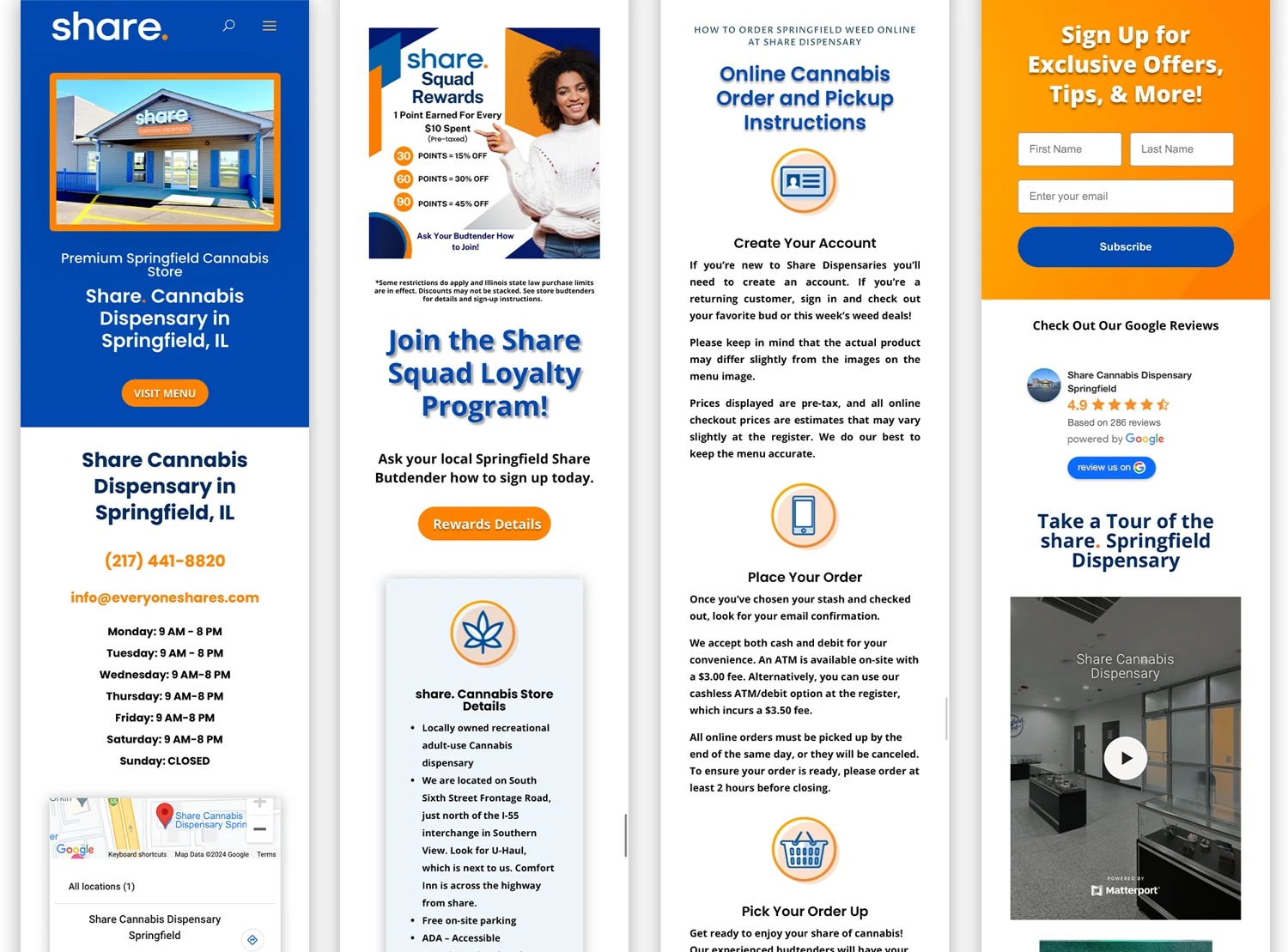
| Find a dispensary location and its menu. | A broad cannabis-marketing article. | The correct store’s page, current visit details and menu destination. |
Verify discovery before commissioning more content
- Production is not accidentally discouraging indexing through WordPress Reading settings.
- Important pages have working links and no unintended indexing restrictions or conflicting URL signals.
- URL Inspection distinguishes Google’s indexed version from a current live test.
- A successful live test or indexing request is not reported as a ranking result.
Help the buyer decide whether to contact you
On AV Social Strategies’ own journey, a buyer can move from WordPress services to an inquiry about a specific website problem. The page and form need to carry that context: what help is available, which situations fit, what information to provide and what happens next. This is a journey to inspect, not a claim about its conversion performance.
Review the page on a phone using one actual buyer question. Check service scope, relevant evidence, common constraints and the next step. Every form field should support qualification, routing or a useful response. A shorter form is not automatically a better form.
Traffic without decision support
- Visitor needs
- A partner who can repair an unreliable website-to-sales handoff.
- Page provides
- Broad claims about attractive design and a generic contact button.
- Unanswered question
- Can this team investigate my connected systems, and what do they need from me?
A clear next conversation
- Explain the scope
- Describe the relevant workflow, investigation and responsibilities.
- Provide useful evidence
- Show a documented example with its context and limits.
- Explain the inquiry
- Ask for the website, problem and business context; state the next step and response window.
Test the whole inquiry path
Verify validation, a successful submission, the receiving record and assigned follow-up. A polished page cannot compensate for a lost request.
Keep the source and denominator beside each measure
Search clicks, analytics sessions and operational inquiries describe different records. Keep the date range, time zone, source definition and deduplication rules visible. Mark unknown sources or missing data explicitly.
Marking an event as a GA4 key event does not verify lead quality. Confirm that it follows successful submission and does not fire for a failure or a repeat visit to a confirmation page.
Use session-scoped acquisition dimensions for sessions. GA4 Traffic acquisition differs from user acquisition; its session key event rate is the share of sessions with a key event. A custom inquiries-per-session calculation is a different measure.
| Measure | Evidence source | Boundary to disclose |
|---|---|---|
| Search visibility and clicks | Search Console: selected pages, period and available queries. | Query coverage is incomplete; clicks do not identify leads. |
| Observed sessions and successful actions | GA4: session source definition and tested event. | Consent, event coverage and duplicate handling affect observed counts. |
| Distinct inquiries | Form, call or CRM records under an agreed source rule. | Exclude spam and duplicates; retain unknown attribution separately. |
| Qualified / not qualified / pending | Sales review of the same inquiry cohort, as of a stated date. | The three groups must add up to the cohort; pending is not rejected. |
| Signed engagements | Confirmed business records linked to original inquiries. | Sales-cycle delay and attribution uncertainty remain visible. |
The same eight qualified inquiries can produce two honest rates
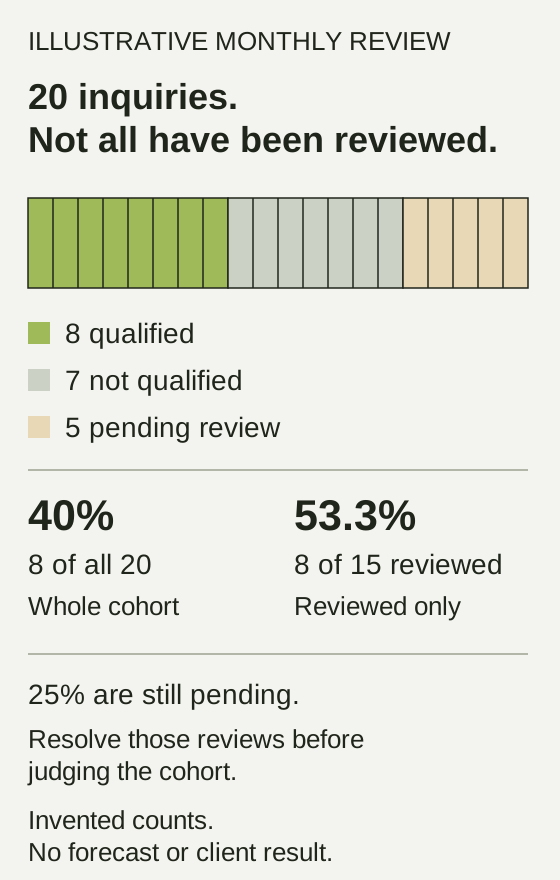
This hypothetical service business has 1,000 tracked organic sessions and 20 distinct inquiries attributed under its documented source rule for one month. At the review date, eight are qualified, seven are not qualified and five are still pending. These are illustrative counts, not AV Social Strategies results.
The operational groups are mutually exclusive: 8 + 7 + 5 = 20. Two inquiries per 100 tracked sessions and 0.8 qualified inquiries per 100 sessions are custom ratios, not native GA4 session key event rates. They do not establish a person-level search-to-sale match.
What the review should do next
- Assign and resolve the five pending reviews before judging the whole cohort’s quality.
- Read accepted, rejected and unresolved examples to distinguish poor fit from missing context or slow follow-up.
- Keep the cohort fixed and add the later review date when outcomes change.
- If none have been reviewed, withhold the reviewed qualification rate.
- Record signed engagements against their original inquiries as the sales cycle matures.
Leave with one improvement and a way to judge it
If relevant searches do not reach the page, investigate visibility. If suitable visitors cannot evaluate the offer, improve its scope, evidence and answers. If requests disappear, fix delivery and ownership. If accepted inquiries stall, address follow-up before calling for more traffic.

Choose an owner, evidence needed and review date for the next change. The business owns accurate service information and sales decisions; its website and search partners own the agreed investigation and implementation. Keep concurrent changes and market conditions visible when reviewing results.
Explore our SEO services or tell us where the inquiry journey breaks. If the issue appears structural, use the repair-or-rebuild guide before assuming a new site is necessary.
Sources and further reading
Google and WordPress documentation supports the search and measurement definitions. The page-intent examples and inquiry chart are illustrative. Their numbers are invented to explain the method, not AV Social Strategies performance or industry benchmarks.